
Water Heater Repair in Boise, ID
Boise Water Heater Experts provides Water Heater Repair in Boise, ID for homeowners, landlords and business owners across Boise, Idaho and the wider Treasure Valley. Most water heater problems trace back to a short list of causes. Knowing which one you're looking at tells you whether you need a quick repair, a maintenance visit, or a conversation about replacement.
Get Your Free Water Heater Quote
Tell us about your water heater needs and we will send you a quote with no obligation.
Common Water Heater Problems and What They Mean
No hot water at all
On a gas unit, this usually means the pilot or igniter is out, the thermocouple has failed, or the gas control valve is dead. On an electric unit, the most common cause is a tripped high-limit switch (the red reset button) or a failed upper heating element. A tripped breaker is worth checking first.
Not enough hot water
Runs out faster than it used to? Suspect sediment stealing tank volume, a failed lower element on an electric unit, a dip tube problem, or a thermostat set too low. If it's never been enough since the day it was installed, the tank may simply be undersized.
Popping, rumbling or crackling noises
That's water boiling under a layer of hardened sediment on the tank floor. Very common with mineral-rich water. A water heater flush is the first move; a tank that has been rumbling for years may already be heat-stressed.
Leaking
Trace the water before assuming the worst. Leaks at the drain valve, relief valve, or the cold and hot connections are repairable. Water from the tank body is not. See water heater leak repair.
Pilot light won't stay lit
Typically a failing thermocouple or flame sensor, a dirty pilot orifice, or a blocked combustion air intake screen. A pilot that repeatedly goes out after being relit needs a real diagnosis, not another match.
Heating element failure
Electric tanks use two elements. Lose the lower and you get a small amount of hot water; lose the upper and you get essentially none. Elements are a routine, affordable replacement.
Thermostat problems
Water that is scalding, lukewarm, or swings unpredictably usually points at a thermostat that has drifted or failed, or at poor contact against the tank wall.
Pressure relief valve discharge
A relief valve that weeps or dumps water is doing its job — the question is why. Excess pressure, thermal expansion in a closed system, or an overheating tank all trigger it. Never plug it.
Sediment and corrosion
Sediment reduces efficiency and capacity. Corrosion at the fittings can be addressed; corrosion on the tank shell means the unit is on borrowed time and replacement is the honest recommendation.
How a Repair Visit Usually Goes
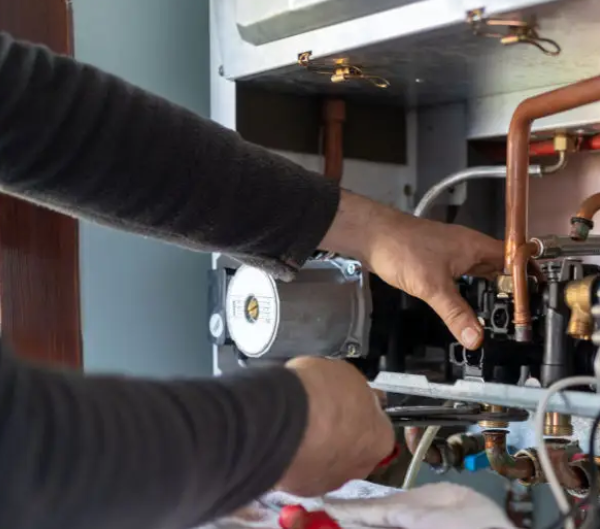
A technician will confirm the symptom, check fuel or power supply, read temperatures at the tank, inspect the venting and burner on gas models or test elements and thermostats on electric models, and check the relief valve and connections for leaks.
From there you should get a clear answer: what failed, what the repair involves, and — importantly — whether the repair makes sense given the age of the unit. On a 13-year-old tank, replacing a gas control valve often costs more than the remaining life is worth.
Repair or Replace? A Practical Way to Decide
- Under 8 years old, single component failure — repair is usually the right call.
- 8 to 12 years, second or third repair — get replacement pricing before authorizing the repair.
- Any age, leaking from the tank body — replacement, without exception.
- Repair quote approaching half of a new install — replacement typically wins on value.
- Household outgrew the unit — a repair won't fix an undersized tank.
If your unit is borderline, maintenance can buy time, but it doesn't reverse corrosion.
Fault Codes and Diagnostic Readings by Symptom
Repair starts with measurement rather than parts. The readings below separate a control failure from a supply, venting or sizing problem.
| Symptom | First measurement | Likely cause |
|---|---|---|
| No hot water, gas unit | Thermopile millivolt output, 550–750 mV open circuit | Weak thermopile, dirty pilot orifice, tripped ECO or failed gas control |
| No hot water, electric unit | 240 V at the upper element terminals, element resistance 10–16 ohms | Tripped high-limit, open element, failed upper thermostat |
| Lukewarm water only | Lower element resistance, dip tube condition | Failed lower element, cracked or broken dip tube mixing cold at the outlet |
| Runs out fast | Recovery rate against first-hour rating | Sediment bed reducing usable volume, or an undersized tank for the household |
| Rumbling or popping | Sediment volume drawn at the drain valve | Hardness scale trapping steam under the sediment layer |
| Short cycling burner | Draft at the hood, flue temperature | Blocked or back-drafting vent, insufficient combustion air |
| Rotten-egg odour | Anode type against water chemistry | Sulfate-reducing bacteria reacting with a magnesium anode |
Which Parts Are Worth Replacing and Which Signal Replacement
Serviceable components: gas control valve, thermopile and pilot assembly, igniter, heating elements, thermostats, high-limit switch (ECO), dip tube, drain valve, T&P relief valve, anode rod, tankless flow sensor, flame rod and fan assembly.
Terminal conditions: weeping or rusting through the tank shell, a corroded flue collar on a heater already past its warranty period, a heat exchanger with confirmed internal cracking, or a heater whose repair estimate approaches half the installed cost of new equipment on an appliance already ten or more years old.
Warranty status changes the calculation. Tanks still inside a six or ten year warranty may qualify for a replacement tank at parts cost, with labour and code upgrades billed separately.
Water Heater Repair Questions Boise Property Owners Ask
Why does my water heater keep running out of hot water?
The usual suspects are sediment buildup reducing usable tank volume, a failed lower heating element on an electric unit, a broken dip tube, or a tank that is simply too small for current household demand.
Is a leaking water heater always a replacement?
No. Leaks at the drain valve, relief valve or supply connections are often repairable. Water coming from the tank body itself means the steel shell has corroded through and the unit needs to be replaced.
Why is my water heater making a rumbling noise?
Sediment has hardened on the bottom of the tank and water is boiling underneath it. A flush often quiets it and restores efficiency; long-term buildup can shorten tank life.
How often do heating elements fail?
Elements are consumables. In hard water they can scale and burn out within a few years, and they are among the least expensive water heater repairs.
My pilot light keeps going out — is that dangerous?
It signals a fault worth diagnosing rather than ignoring: a failing thermocouple, a dirty pilot assembly, or restricted combustion air. Any suspicion of a gas smell should be treated as an emergency and reported to your gas utility immediately.
Can regular maintenance prevent repairs?
It prevents some of them. An annual flush, an anode inspection and a relief valve test address the failure modes that account for a large share of service calls.
Why does the pilot light keep going out?
The usual causes are a failing thermopile with low millivolt output, a contaminated pilot orifice, or downdraft in the vent. A pilot that dies only on windy Boise afternoons points at the venting rather than the control.
Is a hissing or ticking noise urgent?
Ticking after a draw is usually normal expansion in the piping. Hissing at the burner or water dripping onto the burner tray is not, and it typically means condensation or an internal leak.
How long should a repair keep the heater going?
A control or element repair on a heater under about eight years old normally buys several more years. The same repair on a heater at twelve years old is a stopgap, because the tank lining is usually the next component to fail.
Request Water Heater Repair in Boise, ID
Send a few details about your property and your current water heater. We will send you a quote with no obligation.
Not sure which service you need? Choose Not Sure in the form and describe what's happening, most homeowners are diagnosing the problem for the first time.
Get Your Free Water Heater Quote
Tell us about your water heater needs and we will send you a quote with no obligation.