Tankless Water Heaters in Boise, ID
Boise Water Heater Experts provides Tankless Water Heaters in Boise, ID for homeowners, landlords and business owners across Boise, Idaho and the wider Treasure Valley. Tankless water heaters heat water as it flows, so hot water doesn't run out and no energy is spent keeping a tank warm all day. They're a strong fit for many Boise homes — with a few the Treasure Valley considerations worth understanding before you commit.
Get Your Free Water Heater Quote
Tell us about your water heater needs and we will send you a quote with no obligation.
How a Tankless Water Heater Works
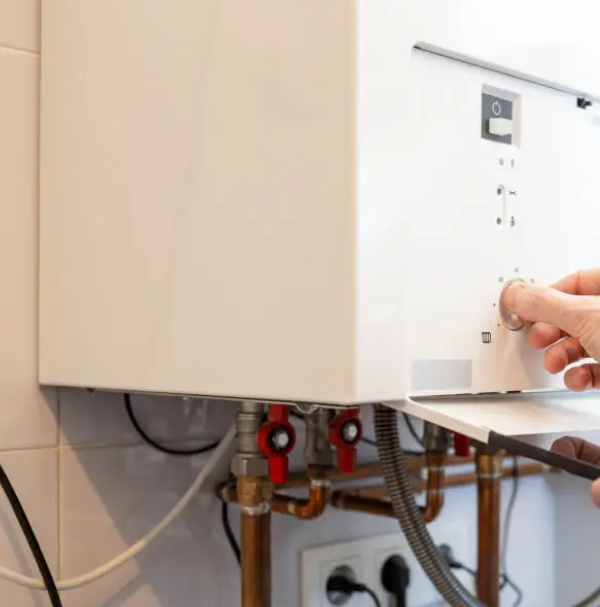
Open a hot tap and a flow sensor fires a high-output burner or element. Water passes through a heat exchanger and reaches the set temperature in seconds. Close the tap and the unit shuts down completely. There is no stored volume, so there is no standby loss and no 50-gallon reservoir waiting to leak.
The practical trade-off: output is measured in gallons per minute at a given temperature rise, not in gallons of storage. That is the number that determines whether two showers can run at once.
Sizing a Tankless Unit for Your Home
Temperature rise is the whole game. Sizing depends on the temperature rise from incoming water to the desired hot-water setting, plus the number of fixtures used at once. In Idaho's cold months, headline flow ratings can badly overstate real-world output.
To size correctly, add up the fixtures you want to run simultaneously — a shower is roughly 1.5 to 2.5 GPM, a kitchen faucet under 2 GPM — then check the unit's output at the required temperature rise, not at the headline rating. Many whole-home installations use higher-output condensing gas models when simultaneous demand is high.
Undersizing is the single most common source of tankless disappointment. It's worth getting right at the quoting stage.
Gas and Electric Tankless Options
Gas tankless
The usual choice for whole-home coverage. Expect dedicated venting (stainless or PVC depending on whether the unit condenses), a condensate drain on condensing models, and often a gas line upsize — these burners draw far more than a tank does at peak. Related: gas water heaters.
Electric tankless
Simpler to vent (they don't), but whole-home electric tankless draws substantial amperage and frequently requires a service panel upgrade. They shine as point-of-use units for a remote bathroom, garage sink or addition. Related: electric water heaters.
Installation Requirements and Maintenance
What installation involves
Wall mounting, new venting with correct clearance from windows and intakes, isolation valves for future service, condensate handling, and gas or electrical capacity verification. See water heater installation for the full picture.
Descaling and upkeep
Mineral-rich water scales heat exchangers. Most manufacturers call for periodic descaling — commonly annually in hard water areas — using the isolation valves a good installer already fitted. Inlet filter screens should be rinsed at the same time. That routine keeps output and efficiency where they should be; see water heater maintenance.
Is Tankless Right for Your Home?
Tankless tends to make sense when: hot water regularly runs out, floor space is valuable, you plan to stay in the home long enough to value the efficiency, or you're already facing venting work.
A conventional storage tank often remains the better value when the current setup meets demand, when upfront budget is the deciding factor, or when gas capacity and venting would make conversion expensive. Both paths are covered under water heater replacement.
Sizing Tankless Capacity for Idaho Inlet Temperatures
Tankless output is a function of temperature rise, not a fixed gallon rating. Treasure Valley groundwater arrives at roughly 45–55 °F in winter, so a 120 °F outlet setpoint calls for a rise near 65–75 °F. The same unit that produces 8 gpm in a mild climate may deliver closer to 4–5 gpm here in January.
| Fixture group | Typical demand | Notes |
|---|---|---|
| Low-flow shower | 1.5–2.0 gpm | Most common single-fixture load |
| Standard shower | 2.0–2.5 gpm | Older valves without a flow restrictor |
| Kitchen sink | 1.0–1.5 gpm | Often overlaps with a shower in the morning |
| Dishwasher or clothes washer | 1.0–2.0 gpm | Many units heat internally and can be scheduled off-peak |
| Two showers at once | 3.5–4.5 gpm | Drives most whole-home unit selection in the valley |
| Soaking tub fill | 4.0–6.0 gpm | Common in Eagle and foothill homes with large tubs |
Gas supply is the second constraint. A 199,000 BTU condensing unit needs the meter capacity and the pipe diameter to deliver full input at the appliance; a half-inch branch that fed a 40,000 BTU tank will not do it, and the fix is either an upsized run or a CSST line back to the manifold.
Venting, Condensate and Descaling on a Condensing Unit
- Condensing models vent in PVC, CPVC or polypropylene as a concentric or two-pipe system, with termination clearances from windows, soffits and the gas meter.
- Condensate is mildly acidic and typically runs 0.5–1.5 gallons per hour of firing; many drains require neutralisation media before discharge.
- Freeze protection matters on north-facing exterior walls in the valley; the internal heaters only work while the unit has power, so a winter outage is a real risk on an outdoor installation.
- Isolation valve kits with service ports should be installed at the outset, so descaling later does not mean cutting into the piping.
- With Boise-area hardness, a vinegar or descaling-solution circulation once a year is the sensible baseline, and more often on well water or where the setpoint is above 130 °F.
Tankless Water Heaters Questions Boise Property Owners Ask
Do tankless water heaters really never run out of hot water?
They deliver continuously as long as demand stays within the unit's flow rating. Exceed that — say, three showers plus laundry — and the temperature drops. Sizing is what makes the promise true.
How long do tankless water heaters last?
Manufacturers commonly cite service lives well beyond a conventional tank, and descaling is a major factor in reaching that. Neglected units in hard water fall well short.
Does a tankless unit need a bigger gas line?
Frequently, yes. High-output gas tankless units demand far more BTUs at peak than a storage tank, so the gas line and meter capacity have to be verified before installation.
Will a tankless water heater work in Idaho conditions?
Yes, when it is sized for the required temperature rise and total simultaneous flow. Add the showers and fixtures likely to run together, then compare that demand with the manufacturer's performance table.
How often should a tankless water heater be descaled?
Annually is a common recommendation in mineral-rich water, and some manufacturers tie warranty coverage to documented maintenance. Isolation valves make the job routine.
Can I put a tankless unit where my old tank was?
Usually, and it frees up floor space — but the venting path, gas capacity and condensate drain determine the final location more than the old footprint does.
Will a tankless unit work with my existing gas line?
Only if the line and the meter can carry the full input rating. A 160,000–199,000 BTU unit usually needs a three-quarter inch or larger run, and the meter capacity has to be checked against everything else on the system.
What is the cold water sandwich?
It is the slug of cool water between two draws while the burner re-fires. A small buffer tank or a recirculation loop with a thermostatic control largely removes it.
Does hard water void a tankless warranty?
Many manufacturers require documented annual descaling to keep heat-exchanger coverage in force. Keeping the service records matters as much as doing the work.
Request Tankless Water Heaters in Boise, ID
Send a few details about your property and your current water heater. We will send you a quote with no obligation.
Not sure which service you need? Choose Not Sure in the form and describe what's happening, most homeowners are diagnosing the problem for the first time.
Get Your Free Water Heater Quote
Tell us about your water heater needs and we will send you a quote with no obligation.