
Water Heater Anode Rod Replacement in Boise, ID
Boise Water Heater Experts provides Water Heater Anode Rod Replacement in Boise, ID for homeowners, landlords and business owners across Boise, Idaho and the wider Treasure Valley. The anode rod is a length of magnesium or aluminum suspended inside the tank whose entire job is to corrode instead of the tank. Replace it on schedule and you can add years to a water heater; ignore it and rust moves on to the steel shell.
Get Your Free Water Heater Quote
Tell us about your water heater needs and we will send you a quote with no obligation.
How the Sacrificial Anode Protects Your Tank
A storage tank is steel with a glass lining. Any imperfection in that lining exposes bare steel to hot water, which is an ideal environment for corrosion. The anode rod is a more reactive metal, so electrochemistry attacks it first. As long as the rod has material left, the tank is protected.
Once the rod is consumed down to its core wire, protection ends and the tank begins corroding. That is the moment the countdown to a leaking tank really starts — and it happens quietly, years before there's any visible sign.
When to Inspect and Replace
- First inspection at around three years, then every two to three years after.
- Sooner if you have a water softener — softened water consumes anodes noticeably faster.
- Replace when the rod is heavily pitted or the core wire is exposed over much of its length.
- Consider it if you get a sulfur or rotten-egg smell in the hot water — switching rod material often solves it.
Inspection is easiest to fold into an annual maintenance visit or a flush, since the technician is already at the tank.
Rod Types and Choosing the Right One
| Type | Best suited to | Notes |
|---|---|---|
| Magnesium | Most municipal water | Strong protection; consumed faster in softened water |
| Aluminum / zinc alloy | Homes with sulfur odor | The zinc content commonly reduces the rotten-egg smell |
| Powered (impressed current) | Difficult water chemistry | Doesn't deplete; needs an electrical outlet |
| Flexible / segmented | Low overhead clearance | Installs where a rigid rod won't fit above the tank |
What the Job Involves
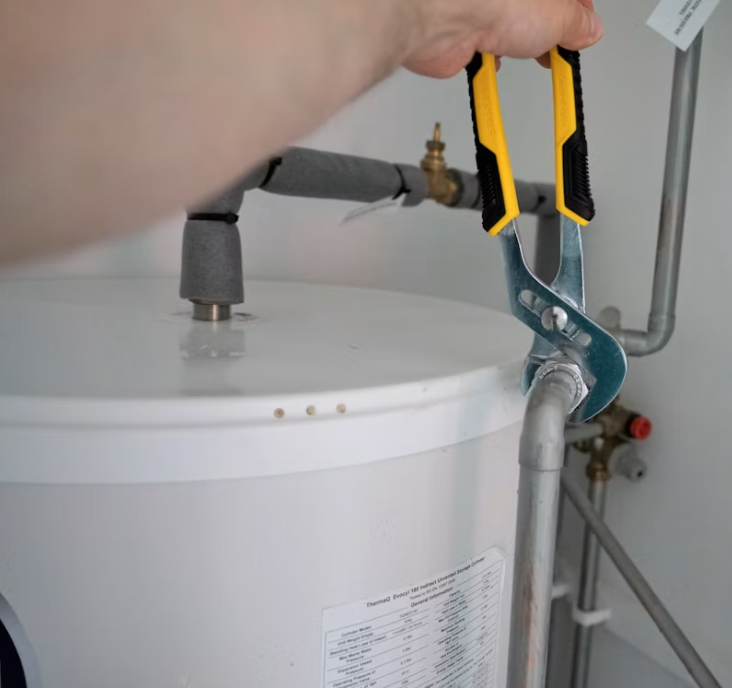
The technician shuts off the heat source and water, relieves pressure, and breaks loose the hex head at the top of the tank — often the hardest part, since rods can seize after a decade. Some tanks have a combination anode built into the hot outlet, which changes the approach. The new rod goes in with fresh thread sealant, then the tank is refilled and checked for leaks.
Low ceiling above the tank? A segmented rod solves that without moving the heater.
Is It Worth Doing on an Older Water Heater?
On a tank under about eight years old with no sign of tank corrosion, yes — it's inexpensive insurance. On a twelve-year-old unit already showing rust at the fittings or base, the protection comes too late and the money is usually better applied toward replacement. A pro can tell you which situation you're in after a look at the rod and the tank.
Anode Metallurgy and Selection
The anode rod is a sacrificial electrode: it corrodes so the glass-lined steel tank does not. Selection depends on water chemistry, which in the Treasure Valley usually means hard groundwater and, in many homes, a softener downstream of the meter.
| Material | Best suited to | Trade-off |
|---|---|---|
| Magnesium | Hard, untreated municipal or well water | Most protective, can produce sulfur odour with certain bacteria |
| Aluminium-zinc | Softened water and odour problems | Longer lasting in aggressive water, slightly less protective |
| Powered titanium | Persistent odour or very aggressive water | Needs power, no sacrificial consumption, higher upfront cost |
| Flexible segmented | Low-clearance closets and garages | Installs where a straight 44 in rod will not fit |
Replacement is due when the rod is consumed to roughly the core wire over a significant length, or is heavily pitted and coated. In softened water that point often arrives in two to three years rather than five.
Access, Tools and Practical Obstacles
- The hex head is typically 1-1/16 in and factory-torqued; an impact wrench and a stabilised tank are usually needed.
- Vertical clearance of about 44 inches above the tank is required for a one-piece rod, which many Boise garage and closet installations do not have.
- Some heaters use a combination anode built into the hot outlet nipple, which changes both the part and the procedure.
- Thread sealant rated for potable water, and a partial drain before removal, keep the job from turning into a leak.
- If the rod cannot be broken loose without deforming the tank top, the sensible answer on an older heater is to plan replacement rather than force it.
Water Heater Anode Rod Replacement Questions Boise Property Owners Ask
What does an anode rod do?
It corrodes in place of your tank. Being a more reactive metal, it attracts the corrosion that would otherwise attack exposed steel inside the water heater.
How often should the anode rod be replaced?
Inspect around year three and every two to three years after. Actual replacement intervals commonly land between three and five years, sooner with softened water.
Can I check the anode rod myself?
It's possible, but the rod is often seized in place and requires significant torque plus proper draining. Many homeowners have it inspected during annual service instead.
Why does my hot water smell like rotten eggs?
It's usually a reaction between a magnesium anode and sulfate-reducing bacteria in the water. An aluminum/zinc rod frequently resolves it.
Does replacing the anode rod really extend tank life?
It's one of the few maintenance items with a direct causal link to tank longevity, because a depleted rod means the tank itself starts corroding.
Do tankless water heaters have anode rods?
Most don't, because there's no storage tank to protect. A few hybrid designs do; descaling is the equivalent maintenance for on-demand units.
How often should the anode be checked in Boise?
Every two years is a sensible baseline on municipal water, and annually where a softener is installed, because softened water consumes the rod much faster.
Will a new anode fix rotten-egg smell?
Frequently, if you change material. Swapping magnesium for aluminium-zinc or a powered anode removes the reaction that produces the odour.
Is anode replacement worth it on a ten-year-old tank?
Usually not on its own. By then the lining has typically taken damage, and the money is better applied to a planned replacement.
Request Water Heater Anode Rod Replacement in Boise, ID
Send a few details about your property and your current water heater. We will send you a quote with no obligation.
Not sure which service you need? Choose Not Sure in the form and describe what's happening, most homeowners are diagnosing the problem for the first time.
Get Your Free Water Heater Quote
Tell us about your water heater needs and we will send you a quote with no obligation.